
In Part 1 of my Black Friday Success Series, we looked at the planning stage, laying your foundations, aligning teams and mapping out your offers and targets.
This post is Part 2 of the 3-part series, where we’ll focus on Build: turning your plans into campaigns and automations that are ready to go. I’ll share tactics to cut through the busy sales period, along with BFCM campaign examples that have caught my eye, so you can get your messaging just right. Then you’ll head into November feeling confident instead of firefighting.
Here are the key areas to focus on next:
1. Segmentation in practice
Your core audiences should already be outlined from the planning phase. Now it’s about confirming them and setting up segments in your Email Service Provider (ESP).
In most cases, you’ll either:
- Stick with your regular BAU segments (new customers, repeat buyers, loyal/VIP, lapsing/lapsed) if your offer is broad (e.g. % off everything). Or, you could flex the offer slightly per segment – for example, active/loyal customers might receive a different incentive to lapsing customers.
- Or adapt your segmentation if your BFCM strategy is more targeted. For example, promoting a specific product/category or a freebie that wouldn’t work for everyone.
To decide whether you need to adapt, ask yourself:
- How many audiences am I targeting?
- Does the same message resonate across all of them, or do some need a different angle (warranting a separate segment)?
- Would certain BFCM campaigns work better as an automation/automations rather than bulk sends? (automations could work really well if you want to do prompt follow-up messages based on specific actions, like a click or conversion)
- If the offer is category-specific, should I separate that audience for tailored messaging?
- Do I have subscribers who joined just for BFCM updates and if so, how can I treat them differently?
- Could there be an opportunity to re-engage last year’s BFCM buyers separately?
- Who should be excluded due to poor offer fit (e.g. recent buyers/already owns product), lifecycle stage or list health?
⚖️ Additional consideration: If you’ve got a particularly strong BFCM offer, you could consider a narrow expansion to slightly less engaged subscribers who might respond. But proceed carefully:
- Don’t cast the net too wide – be realistic about whether these subscribers are the right fit.
- Run the list through a cleaner first (e.g. Kickbox, NeverBounce).
- Start small: test with a limited proportion of this audience and only scale up if results look good.
- Keep frequency low and monitor engagement closely.
💡 The principle: widening the net a little can work, but never at the expense of deliverability or your brand reputation.
The goal is to keep segmentation simple but effective. Enough nuance to send relevant messages (and carefully test the edges, if it makes sense for your brand), without overcomplicating execution so you can better manage the pace.
2. Define your messaging (with campaign examples)
With your offer locked in, the next step is deciding how you’ll present it. During BFCM, clarity wins. Your subscribers will be drowning in emails, so you’ve got just a few seconds to grab attention and make your offer obvious. Keeping a simple, single-minded focus is usually best. This is not to say you can’t include supporting content, but be really clear on the primary action you want the subscriber to take and keep it above the fold.
Start with the basics:
- Subject line: Lead with the value. Use tactics like urgency (“Ends midnight”), exclusivity (“Early access for VIPs”), scarcity (“While stocks last”), or clarity (“25% off everything”). But remember to be genuine – if it’s not exclusive, don’t pretend it is. Emojis can be powerful, but only if they fit your tone of voice.
- Headline: Don’t bury the offer. Make it the first thing the reader see.
- Body copy: Keep it short. A sentence or two max before the CTA.
- Promo code: Always make it text so it’s easy to copy and enter in the checkout.
- CTA: Clear, action-led and consistent. “Shop now” or “Claim your discount” beats clever wording. You could also test a call-to-value (CTV): instead of telling subscribers what to do, highlight what they’ll get. For example: “Save 10% today” or “Start your transformation.”
Creative tactics to try:
- Emojis to catch the eye.
- Animated GIFs (keep file size light for inbox performance).
- Countdown timers to drive urgency.
- Product carousels to showcase bestsellers.
- Imagery that directs the eye to the CTA (e.g. a model’s gaze or a pointing figure).
- Interactive features like offer reveals or scratch cards.
- Polls and quizzes (could work as a way to collect interest/preference data pre-launch).
Campaign examples
Here are four different approaches to BFCM messaging, each showing a tactic you can learn from. Whether that’s keeping things clear, creating exclusivity, adding urgency or focusing on value.
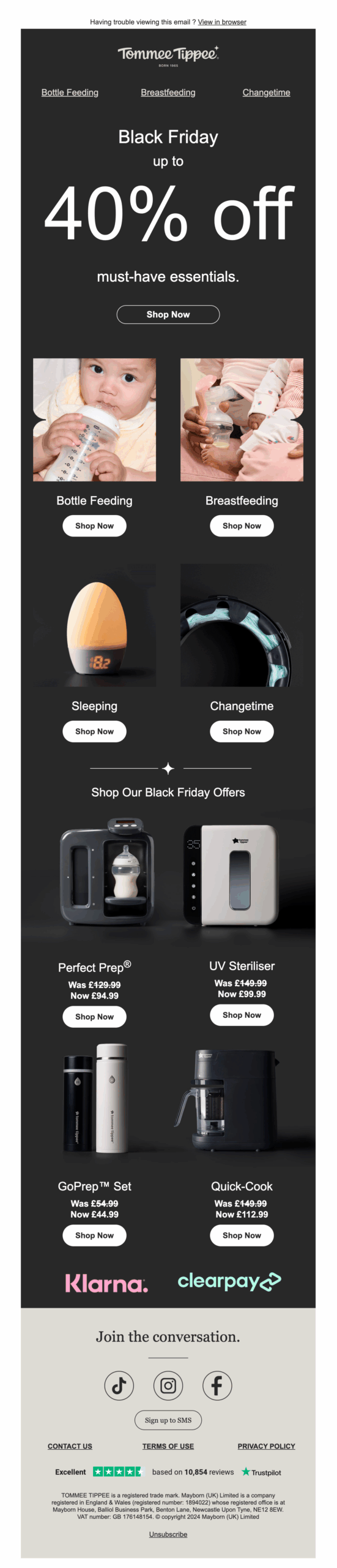
Tomme Tippe: Clear and singled-minded
A bold, uncluttered headline puts the discount front and centre. Not the prettiest design, but a great example of clarity winning over complexity. The category product imagery in the second part of the email is also animated, switching between a product image and an in-situ image of the product – making it that little more eye-catching (sorry I couldn’t figure out how to show the gif here!).
Subject line: Black Friday: Up to 40% off must-have essentials
JBL: Exclusivity
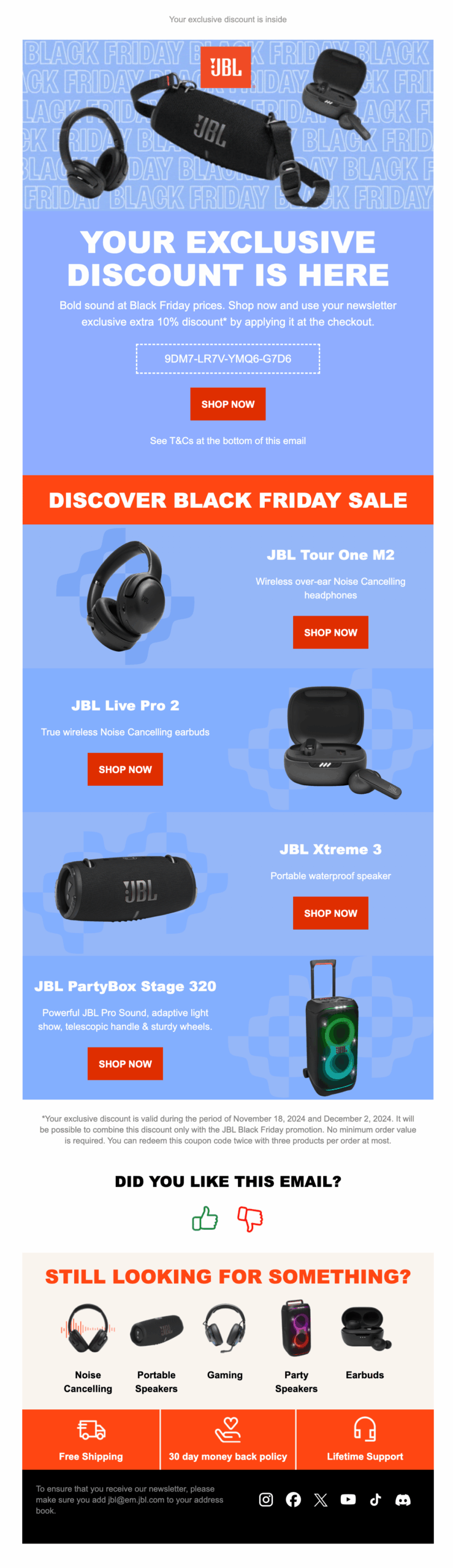
JBL leans into exclusivity by making the subscriber feel singled out. A unique discount code adds to the personalised feel. The banner imagery was also composed of an eye-catching Gif. The main content block is followed up with popular sale products, they also have a short in-email poll where users can respond to say if they liked the email or not, a great example of interactive email.
Subject line: Your exclusive discount is here
LEGO: Creative urgency
This email from Lego is a great example of how to build excitement for an incoming Black Friday Sale. They hint at what’s going to be on offer (The Endurance Ship) and prompt building your wish lists in advance. The email closes out with a countdown timer to layer in that extra level of urgency for the start of their sale.
Subject line: Black Friday Sale incoming

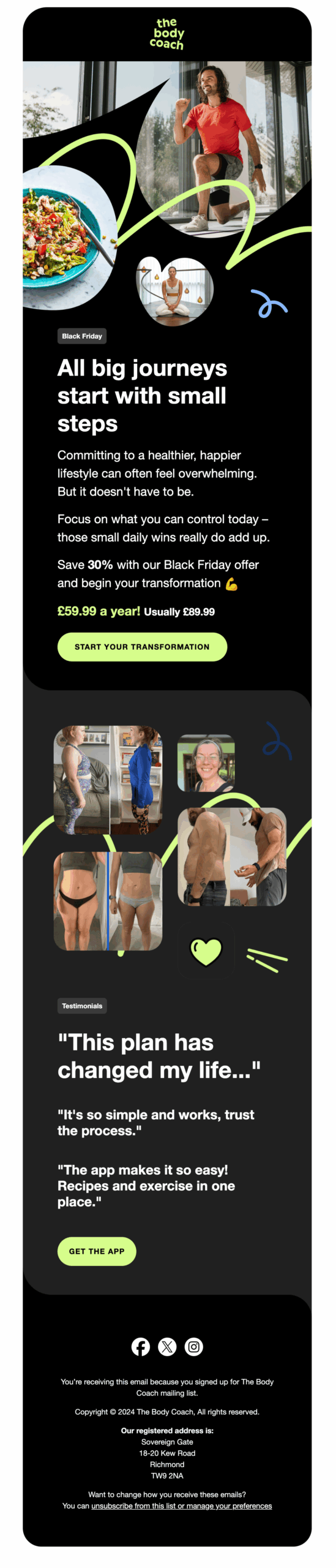
The Body Coach: Call-to-value
I just had to share this example from The Body Coach, it stood out for the way it reframes the discount as a benefit: “Start your transformation.” A smart example of a call-to-value (CTV) in action. Love how it’s backed up with real customer before and after imagery. The Black Friday mention itself is fairly small, but The Body Coach consistently switched up it’s brand colours during this sale period to the green and black (from blue and white) to remind readers this was part of their Black Friday offering.
Subject line: Emma, save 30% and kickstart your fitness journey 💪
💡 The takeaway: There’s no single right way to do BFCM messaging. What matters is making the offer obvious, keeping the focus clear and choosing tactics that fit your brand. Whether you lean on simplicity, exclusivity, creativity or value-led copy, the key is to avoid clutter and keep the subscriber’s next step front and centre.
3. Smart delivery & cadence tactics
It’s not just what you send, but how you deliver it. These behind-the-scenes decisions can support deliverability, prevent overwhelm and keep your brand visible during the busiest inbox season of the year:
- Throttling: Stagger large sends to protect deliverability and avoid sudden traffic spikes that could crash your site or overwhelm your teams.
- Past-the-hour sends: According to Validity, the majority of emails are sent in the first 10 minutes of the hour. Try scheduling at 12 minutes, 15 minutes or even 18 minutes past to dodge the peak and have more chance of being seen.
- Send-time optimisation (STO): If your ESP supports it, deliver when each subscriber is most likely to open.
- Frequency management: This is important for email only, but also think cross-channel. If you’re layering email with SMS, push, or social, plan your cadence so customers don’t feel overwhelmed.
- AI channel affinity: Tools in platforms like Braze and Klaviyo can predict which channel (email, SMS, push) an individual is most likely to engage with – a smart way to balance reach without overloading.
A few smart adjustments in timing, cadence and channel mix can make all the difference to visibility, audience reception and performance when inboxes are at their busiest.
4. Plan to test & learn
BFCM isn’t the time to run endless experiments, but it is the time to make sure your testing has purpose. Whether you run pre-tests in October/live tests during the sales period, the goal is the same: learn something meaningful that helps you optimise performance.
The key is to have a clear roadmap. Don’t improvise on the day. Decide in advance:
- What you’re testing.
- Why you’re testing it (your hypothesis).
- Which KPI will prove or disprove it.
- And remember to document it.
Build your hypothesis
Each test should answer a real question, not just “let’s see what happens.” Write down a clear hypothesis with a defined KPI.
Examples:
- Readers will respond better to urgency-based subject lines (“Ends midnight”) than scarcity-based ones (“Only 50 left”). KPI: conversion rate.
- Readers will click more on a call-to-value CTA (“Save 20% today”) than a call-to-action CTA (“Shop sale now”). KPI: click-through rate.
Choose your test type
- A/B tests: One change vs another.
- Multivariate tests: Multiple variations at once (useful if you have large audiences).
Note: You’ll need a big enough audience for valid results.
Aim for significance
Ideally, you want to see 95%+ statistical significance before declaring a winner. Most ESPs will calculate this for you, but be cautious about drawing conclusions too quickly if volumes are low.
Keep it focused
Testing for the sake of testing is a distraction. Focus on questions that matter to your BFCM strategy – messaging styles, CTAs or send times that could shift performance at scale.
Example: In a past test (not during BFCM), I compared benefit-led vs value-led messaging to see which resonated more. For BFCM, you could adapt this to test “big headline discount” vs “early access exclusivity” to see which style lands better with your audience.
Testing should sharpen your BFCM performance, not slow you down. With a clear roadmap, you’ll capture meaningful insights without losing focus on execution.
5. QA checklist for campaigns & automations
As with any campaign, it’s crucial to run through a QA process before you hit send. A proper QA ensures your emails look and behave as expected and prevents small errors from undermining your BFCM efforts.
Here are the checks I’d always recommend:
Campaign content
- Test send your campaign.
- Double check subject line, preheader, body copy, T&Cs and creative.
- View the email in multiple inboxes and devices for rendering issues (Some platforms have built in inbox rendering tools or there are external options like Litmus, Email on Acid etc which can help).
- Check dark mode and images-off views (for the best accessibility).
- Test every link.
- Walk through the full customer journey, especially promo codes and redemption.
- Confirm all personalisation and dynamic content populate correctly.
Scheduling
- Verify send time and date.
- Check sender profile settings (critical if you have multiple).
- Confirm the right segment(s) is selected.
- Make sure excluded segment(s) are applied if needed.
- Set up any A/B or multivariate test versions with correct evaluation metrics.
- Review rate limits/throttling (particularly for large sends).
Automations
- Review entry, exit and goal criteria.
- Test each branch of the flow to ensure logic works as expected.
Cross-channel alignment
Don’t stop at email – check that supporting assets are aligned across landing pages, website banners and forms. The experience should feel seamless from inbox to checkout.
If you’re also running SMS, push, in-app, or in-browser messaging, make sure:
- Messaging and creative are consistent across channels.
- Timing and cadence are coordinated (so customers aren’t bombarded).
- Promo codes and the path to redemption is clear across touch points.
💡 Think of it as an end-to-end test: From the subject line in the inbox right through to the thank you page after purchase. Every step should work and every message should feel connected.
Wrapping up
Part 2 is all about execution. By the end of this stage, your campaigns, automations and testing should be scheduled so you can head into November with confidence.
👉 Next in the series: Part 3 – Launch. We’ll cover how to manage once campaigns go live, keep teams aligned, monitor performance and adapt quickly during BFCM. Plus, we’ll take a look up how you can follow up and make the most of your BFCM shoppers.
If you’d like extra support over the busy sales period, my CRM Collaborative retainer is designed to give you flexible, on-demand help with your CRM and email marketing. Whether that’s building campaigns, optimising automations or sharing a second pair of eyes on your strategy.