

A welcome series is a sequence of automated emails sent to new subscribers over the first few days or weeks after they join your email list. It’s either your biggest revenue opportunity or your biggest missed opportunity in email marketing. According to GetResponse, welcome emails have open rates up to 4x higher than standard newsletters and Omnisend reports that multi-email welcome series (3+ emails) can generate 90% more revenue than single-send versions. Getting this automation right can transform your email marketing results.
Why a welcome series work so well
If someone has shown interest in your store by joining your email list or creating an account, you have a narrow window to onboard and nurture them properly. It’s time to strike while the iron is hot and introduce your brand, build trust and start a blossoming relationship with your new subscriber.
Some users may be signing up, because they are ready to buy (and possibly want a discount/freebie to do that), others might be interested in what you have to offer but need more information to nudge them to that first purchase.
Now that you understand the power of welcome series, let’s talk about who should be receiving them – because not all new subscribers are the same.
Define your audience: Who gets your welcome series
Typically your welcome flow will be for new subscribers joining your list via a pop-up, landing page form or by creating an account.
The objective of a welcome journey is to drive that prospect to make their first purchase with your brand.
Your different sources for sign up may have different propositions, so remember to deliver what you’ve promised straight away. For example, someone who signed up for a discount should receive that promotional code in their first email. Whereas, someone who joined based on a value based message with no promotional incentive, will receive a welcome email with a proposition tailored to that.
Your flow should check if they’re already an existing customer and treat them accordingly, this could be an exclusion or sending them down a different path/into another automation with content tailored to that status.
Once you’ve identified your audience segments, the next critical decision is timing. Get this wrong and even the best content won’t convert. Send too frequently and you seem desperate; wait too long and the moment’s gone.
Timing and frequency: How many emails to send and when
As with any successful email marketing strategy, timing is key. The biggest tip I can give you is to send that first email straight away. If someone is signed up, they’re expecting your brand to respond with a confirmation not tumble weed…
Every audience is different, however, it’s best to send more than one email in your welcome journey. Research from Omnisend shows that welcome series with 3 or more emails significantly outperform single-email approaches.
I’d usually suggest an email every other day for at least a week. However, you know your audience best. Factor in your customer lifecycle, frequency of emails/other communications and how long the average purchase cycle is to get the balance right. The number of emails you send will also depend on the content you have available to share, but I’m sure you have more than you think.
Once they’ve made that all important first purchase, they can start to receive your BAU campaigns and get entered into any other relevant lifecycle triggers like a post-purchase automation.
With your timing nailed down, let’s dive into the nitty gritty of your welcome series – the content. What you say in each email will determine whether subscribers become customers or hit unsubscribe. Here’s exactly what each message should contain…
The complete email breakdown: What to include in each Message
Your welcome flow should do these key things:
✅ Respond immediately to their sign-up with the incentive you promised.
✅ Tell them more about your brand, what makes you different, how you can help them.
✅ Demonstrate your product range and categories, showcase your bestsellers.
✅ Help subscribers overcome common barriers to purchase by providing educational and informative content.
✅ Build trust through social proof by incorporating review scores, customer counts and testimonials throughout every email.
✅ Showcase customer transformations by sharing detailed success stories that demonstrate real results and outcomes.
✅ Be personalised to the subscriber.
✅ Remind them of their offer before it expires (if there is one).
💡 Pro Tip: Every email in your welcome series should include some form of social proof – whether it’s review scores, customer counts, testimonials or trust badges. The key is making it support your primary message rather than compete with it.
A typical flow might look something like this:
Email 1: Warm welcome and deliver incentive promised
Make sure you also cover off setting expectations e.g. a reminder of how often you send and what type of content they’ll receive.
Example: LookFantastic – Discount based incentive
Subject line: Hey newbie, here’s a treat on us 😍
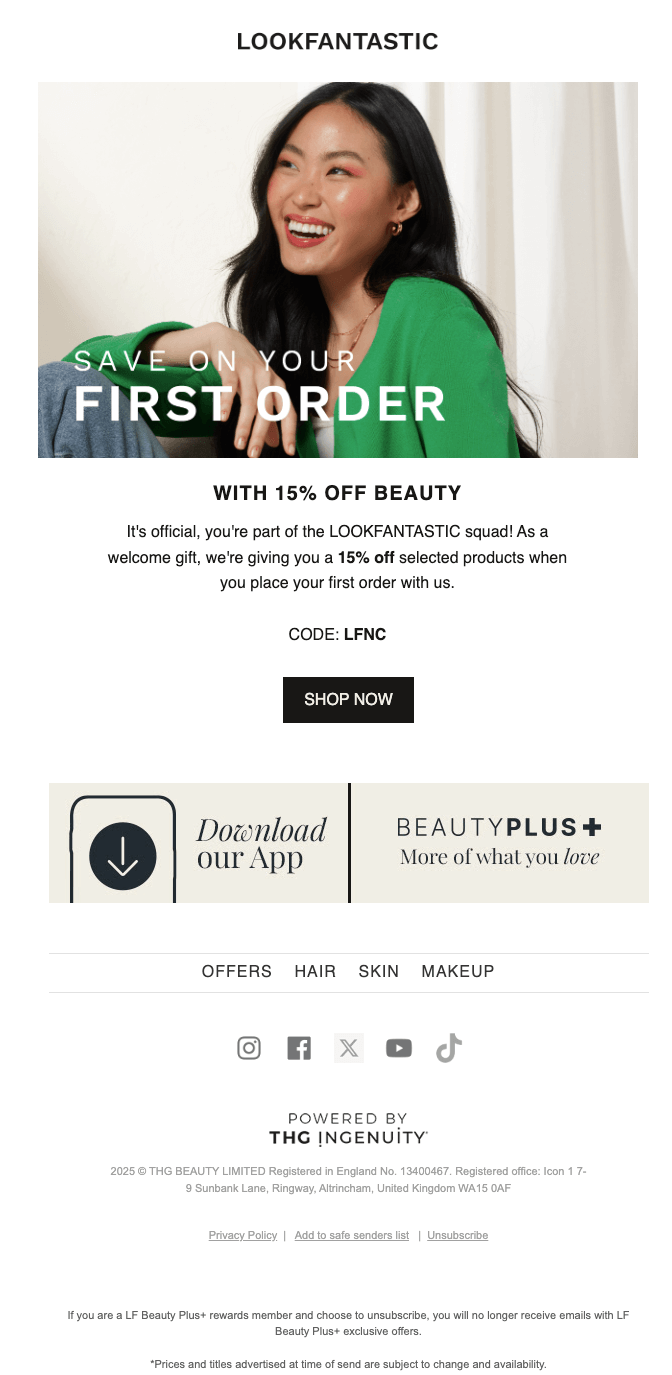
Quick breakdown
- Opens with a playful subject line (“Hey newbie…”), immediately setting a friendly, informal tone.
- Prominently displays the 15% welcome offer, with a clear CTA that encourages quick action.
- Keeps the message single-minded, focusing entirely on the discount without distraction.
- Uses a text-based promo code, making it easy to copy, although visually it could stand out more.
- Could benefit from expectation-setting, like frequency or content type but still works well as a first impression.
- Could strengthen creditability by referencing their 4.6/5 Trustpilot rating and the fact they have over 355,000 reviews.
Example: AO – Value based incentive
Subject line: Welcome and thanks for signing up to our newsletter!

Quick breakdown
- Sets a warm, inclusive tone from the start, using “You’re in the family” to make subscribers feel welcome and part of something.
- Clearly outlines what to expect, from product inspiration to exclusive content which is ideal for setting expectations early.
- Keeps the focus on brand personality over hard selling, making it a strong first touch for brands without an upfront incentive.
- Smart use of social proof with “300,000+ Trustpilot reviews”, building trust without taking focus off the welcome message.
- Repeats the subject line as the headline, which feels like a missed opportunity to add more personality.
Email 2: Brand story & values
Tell your story in a way that’s fun and drives curiosity, share your values and real photos of the team. This shows your human not just a faceless corporation. Share your social media profiles – where else can they find and interact with your company.
Example: Unplugged
Subject line: Welcome to your antidote to busy life 🌲🔕
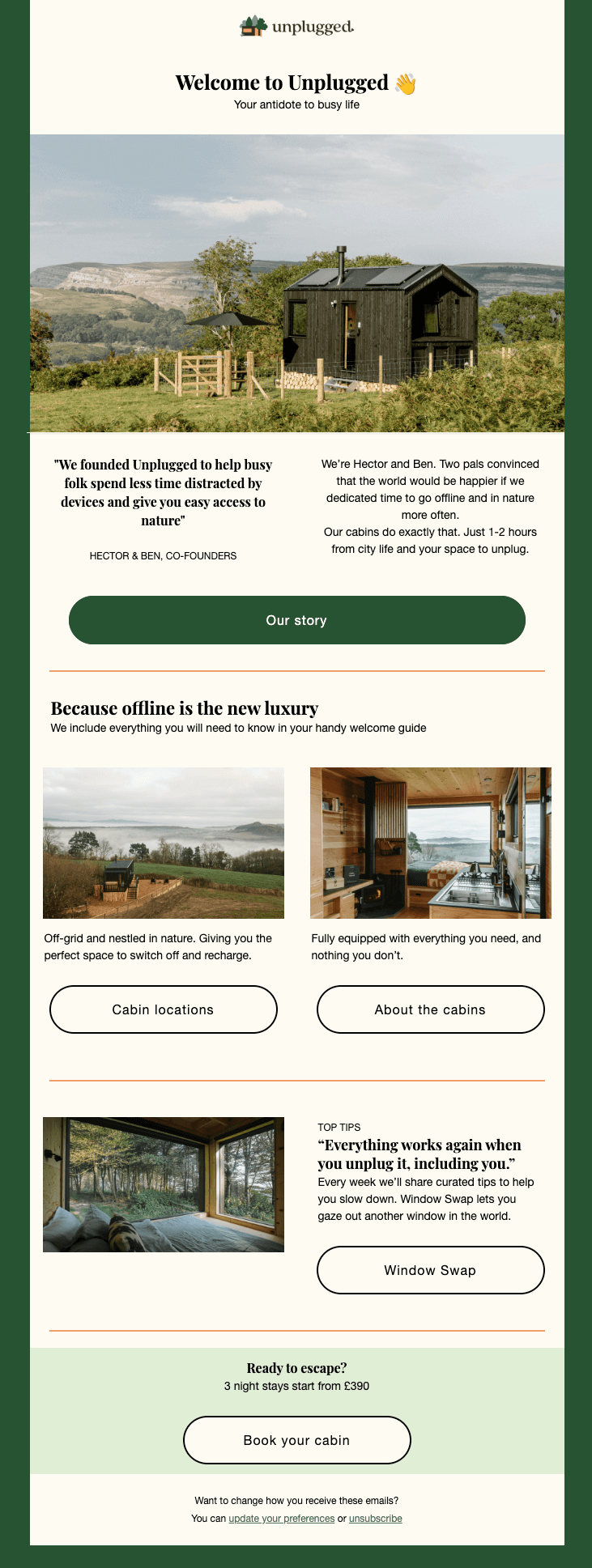
Quick breakdown
- Opens with a warm, founder-led message, creating a personal connection and introducing the brand’s purpose. A picture of the founders here would have been a nice additional touch.
- Frames the experience around digital detox and nature, clearly expressing Unplugged’s values without being preachy.
- Uses a helpful welcome guide to lead subscribers toward booking, packaging cabin info and locations as part of a value-first experience.
- Closes with a gentle booking prompt, encouraging a three-night stay without disrupting the overall tone.
Email 3: Product focus
Showcase your most popular product(s) or even better base this on the category/specific product(s) you know the user browsed. Support the sales focus with additional helpful information like FAQs or how to contact support, where to find delivery & returns information.
Example: Puresport
Subject line: The Puresport product guide
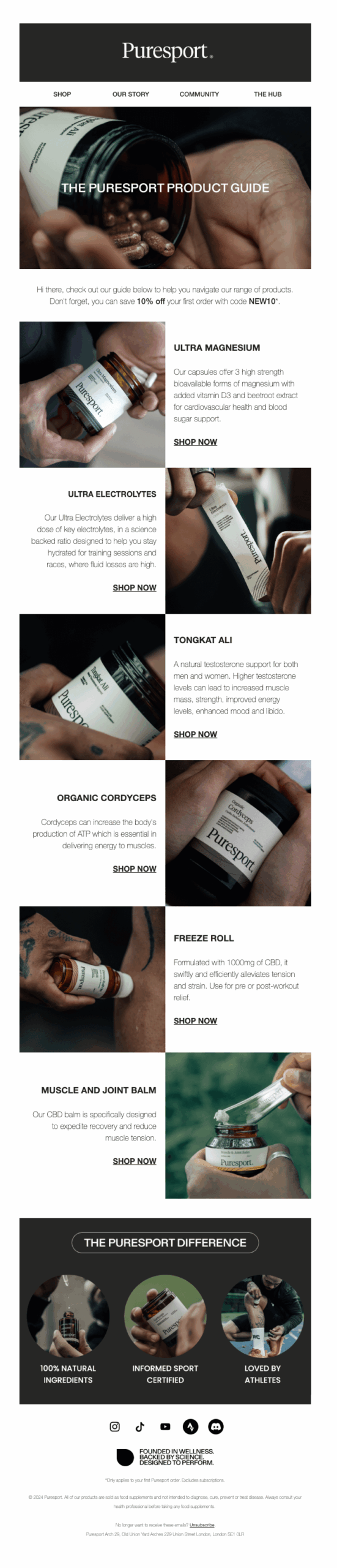
Quick breakdown
- Gently reminds subscribers of the 10% welcome offer, keeping the incentive top-of-mind without dominating the message.
- Showcases hero products with clean, consistent visuals, making it easy to scan the full range at a glance.
- Gives a clear sense of what each product is for, with concise descriptions that highlight purpose, ingredients, or science-backed claims. Adding star ratings here would provide instant creditability for each product
- Includes clear, repeated CTAs of “Shop now”, but keeps them light and non-intrusive within the layout.
- Closes with what makes them different, reinforcing key USPs like natural ingredients, effectiveness and transparency.
- Notice how they close with differentiators – this would be perfect placement for customer testimonials.
Email 4: Overcome objections
Point out common pain points and how your product/service can help overcome these. Use evergreen content from your blogs and landing pages. Tell the subscriber what makes you different from your competitors with your USP’s.
Example: Daye
Subject line: Your flow, your way 🩸
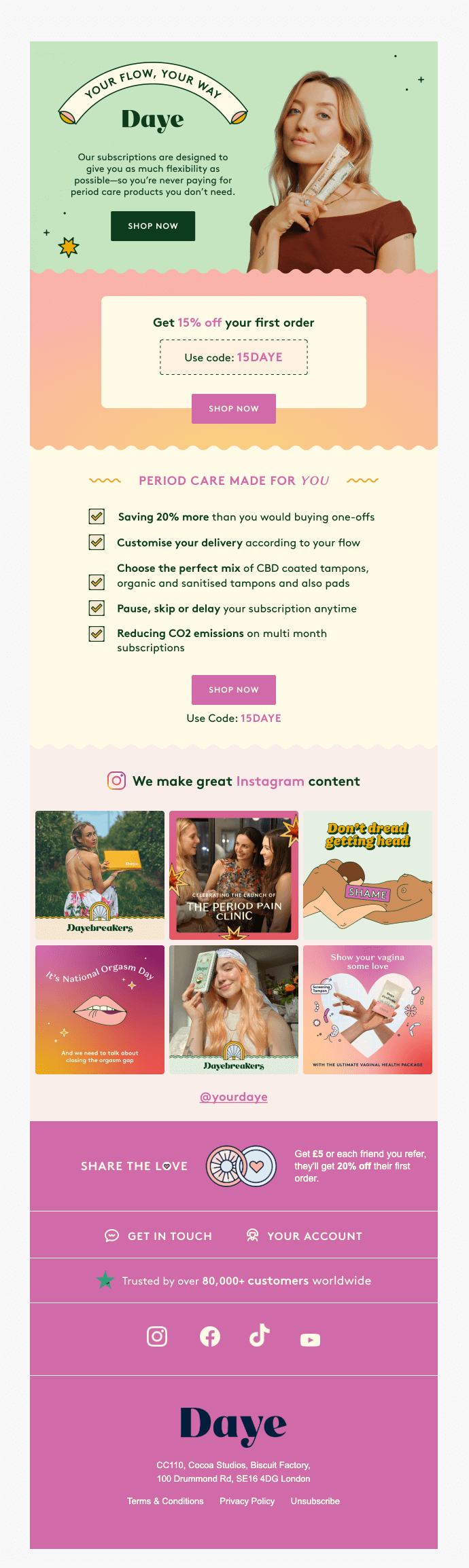
Quick breakdown
- Uses benefit-led messaging to ease concerns, like “Pause anytime” or “Customise your box.”
- Features are framed as objection-busters, such as flexibility, eco materials and subscription control.
- Reinforces the 15% welcome offer (mentioned in the initial email), giving hesitant subscribers another nudge to convert.
- Clean layout educates and drives action, guiding readers from reassurance to CTA smoothly.
- Nice use of social proof to close out the email with “Trusted by over 80,000+ customers worldwide”.
Email 5: Incentive reminder
Give subscribers another nudge if they’ve not redeemed their offer. Create a sense of urgency by having the offer be time limited. Think countdown timers and last chance messaging here.
Example: Tonies
Subject line: Don’t forget, you’ve got 15% off 💌

Quick breakdown
- Creates urgency around the offer with phrases like “Don’t miss out” and “Be quick.”
- Uses a unique-looking discount code, helping the offer feel more personalised and exclusive.
- Reinforces product value through repetition, showing bestsellers and bundles together.
- Highlights social proof from trusted sources, including parenting and media brands like BookTrust and The Independent.
- Keeps the tone friendly and persuasive, encouraging action without feeling pushy.
Email 6: Introduce loyalty rewards (optional)
For brands with established loyalty programs, don’t miss your first opportunity to shout about it! When prospects think about the longer term benefits of shopping with you, this could be something that stands you apart from your competitors. Even if it’s not, a rewards scheme is guaranteed to entice readers and make them think twice.
💡 Pro Tip: Remember that purchasers exit your welcome series and will likely enter a post-purchase automation. Your loyalty program email can work in both flows – as a final conversion attempt for hesitant subscribers and as part of new customer onboarding for those who’ve already bought (and didn’t see this email before).
Example: Sephora
Subject line: We’re more than just 35,000 products

Quick breakdown
- The subject line drives curiosity, as it makes the reader wonder what the “more” is referring to.The mention of “35,000 products” also adds heft to their offering.
- Visual hierarchy guides the eye through clear sectioning with headers like “Our Exclusive Sephora Perks” and “Only at Sephora” to make benefits easy to scan and digest.
- Loyalty scheme is introduced simply to the subscriber – it’s clear it works using points and tiers (bronze, silver, gold).
- The App is positioned as another way to access exclusive offers and be the first to know about new launches.
- A push to their blog content (“Tips, tricks and so much more”) works well to break up the sales push and add educational value.
- Multiple CTAs are strategically placed throughout different sections giving subscribers multiple entry points based on their interest level without overwhelming.
These six emails provide your content framework, but here’s what many brands miss: where you direct people matters just as much as what you tell them. The most beautifully crafted email falls flat if it leads to the wrong destination.
Where to drive people (it’s not just about the sale)
Obviously you want the sale, but from a new subscriber’s point of view, that’s not always their immediate priority. Repeated ‘BUY NOW’ emails can backfire, turning subscribers off instead of drawing them in.
Instead, subscribers want to understand what sets you apart from competitors, explore your product range, and learn about your shopping experience — delivery options, returns process, support channels, and shipping times. The key is to pepper your sales content with informative, educational material. Tell readers how to get the most benefit from your products, or show how your offering solves the common pain points that attracted them in the first place.
Look at your blog content and other website resources like help-based landing pages for content ideas. Another goldmine is your customer service team – what questions do first-time purchasers commonly ask? Build content around these FAQs to address concerns upfront, resulting in a quicker path to purchase.
Also, don’t forget to tell them where else they can interact with your brand by sharing your social media profiles.
Creating your welcome series is just the foundation. The brands that see exceptional results are those that continuously refine their approach based on real performance data. Here’s how to turn your good welcome series into a great one…
Measuring and optimising your welcome series performance
The most important thing about any marketing automation is to review the performance regularly ( I’d recommend once a month, but quarterly at a minimum). Determine your key KPI’s, like open rate, click-through rate, conversion rate and revenue per email and track them over time for the flow, as well as for the individual emails within it.
You’ll begin to spot trends and anomalies in the data, helping you to build hypotheses on how to optimise and improve the performance of the welcome series. Use these insights to create a testing roadmap for A/B or multivariant tests – from subject lines, personalisation and timing, to more strategic experiments like testing different persuasion angles (e.g. focusing on product benefits vs highlighting value or savings).
Even the most data-driven optimisation strategy can’t save a welcome series from fundamental flaws. I’ve seen brands lose potential customers to these easily avoidable mistakes.
Avoid these common welcome series pitfalls
Here are the most costly mistakes I see brands make and how to avoid them:
Setup mistakes
- Taking too long to send the first email: Respond instantly while the pot’s still warm, don’t let someone who’s shown interest slip away.
- Remember to remove purchasers: They’ve achieved your exit criteria for the welcome flow, now take them onto the next step of their journey with you.
- Treating everyone the same: Think about how you can break your automation down further, if someone clicks email 2, can you send them email 3 sooner or could you send them different content based on what they engaged with versus someone who didn’t? Also think about where they go next, purchasers are different to those that don’t convert, can you tailor your BAU to those segments or what other automations might be better placed.
- Missed opportunity to collect first party data: When someone joins your list, they’re warm and willing to interact with you. Why not take this opportunity to collect some more data on them and use it to tailor further? You could use interactive content to do this directly in the email, or add a second (optional) step to the sign-up form.
- Too many emails or not enough: It’s a fine balance and every brand will be different, and even every customer. This is where your knowledge comes in, use what you know to test and optimise the perfect cadence and timeframe.
Content mistakes
- Sign-up messaging misalignment: If your pop-up says “Sign up for 10% off” deliver 10% off straight away, not on the second or third email. If you don’t deliver what you promise it will likely lead to an unsubscribe.
- Trying to do too much in one email: Use each email to focus on one core message, don’t bombard your audience or they won’t know what to do next or where to click. It’s all about a single minded proposition.
- Lack of personalisation: I’m not just talking first name here, you can use things like sign up source, behaviour on site e.g. products/categories browsed, number of visits to your website, preferences collected for channel and content.
- Not using social proof strategically: Don’t just sprinkle in a few reviews, build credibility systematically through every email, or consider a dedicated transformation story email for products with measurable results.
Final thought
A good welcome flow can see you increase that first time conversion rate number for your business and help you on the way to building a lasting relationship with your new customers.
If you’re not seeing the results you want from your welcome series or haven’t got one in place yet, I can help. Get in touch about my Flow Forward service, designed to help you optimise or create new automated email flows.